
Prescription costs are rising, but seniors have several options for saving money. Learn more about p...
Using federal data from the U.S. Census Bureau, we found 3.8 million Hispanic Americans aren't getting the mental health care services they need. Our report explores the issue, including expert public health analysis and local Spanish-language resources to help serve Latino Americans.
![Umbraco.Cms.Core.Models.MediaWithCrops`1[TzDigitalUmb.HelpAdvisor.Web.ContentModels.Image]](https://res.cloudinary.com/tranzact/c_fill,g_faces:center,h_300,w_700/f_auto,q_auto,c_limit,w_2000,h_2000/f_auto,q_auto,c_limit,w_2000,h_2000/v1/Umbraco/tz-helpadvisor/hispanic-family-at-cookout)
Using data from the U.S. Census Bureau’s Household Pulse Survey, HelpAdvisor.com identified the states with the biggest disparities between White and Hispanic adults for unmet mental health needs.
According to our findings, 3.8 million Hispanic Americans say they don't get the mental health counseling and treatment they need.
Hispanic Americans are particularly vulnerable to challenges in receiving mental health care services they need. Language barriers, cultural differences and a lack of available resources are just some of the reasons why this demographic may experience an increased rate of undiagnosed or untreated mental illness.
Nearly half of all individuals with a mental health issue are left untreated. And an untreated mental illness can have damaging effects on relationships, school and work, physical health, other mental illnesses, substance abuse and overall social well-being.
The map below displays where the greatest disparities exist between Hispanics and Whites reporting unmet needs for mental health counseling, which means they needed mental health counseling or therapy but weren’t able to get help.
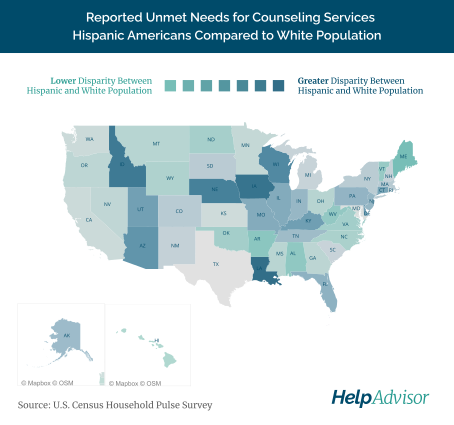
As illustrated by the map, a pocket exists in the Midwest, between Nebraska to the west, Kentucky to the east, Tennessee to the south and Wisconsin to the north, where a much higher number of Hispanic Americans are reporting unmet mental health needs compared to Whites.
Louisiana reported the highest gap between the numbers of Hispanics and Whites who report unmet mental health needs, but the state is surrounded on all borders with states of low to medium reported levels of such differences.
Dr. Carlos Garcia, Licensed Clinical Psychologist –
“The majority of mental health professionals do not speak Spanish, nor have they been sufficiently educated in Hispanic culture. This often results in miscommunication and misinterpretations."
17.4% of Hispanics in Louisiana report having unmet mental health needs, which is significantly higher than that of the state with the next highest rate (Idaho, at 12.4%).
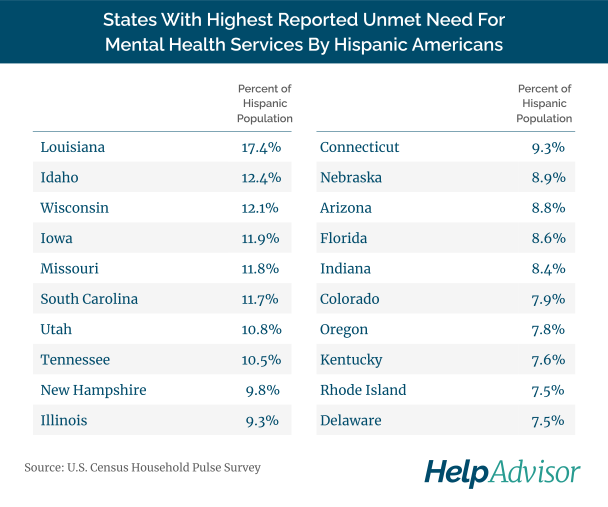
The states with low Hispanic per-capita populations tend to be the states with the highest disparities between White Americans and Hispanic Americans who don’t get the therapy and counseling they need. For example, none of the nine states with the highest per capita populations of Hispanics ranked among the top 10 in terms of unmet mental health needs.
One reason for such challenges could be that states with higher percentages of Hispanics may have more resources available to Spanish speaking residents. Dr. Carlos Garcia, a licensed clinical psychologist in Tampa, FL, suggests that a disparity in the number of Hispanic therapists and counselors may discourage individuals of the same background from seeking help.
“The American Psychological Association found that only one percent of psychologists identified themselves as Hispanic even though Hispanics represent 20 percent of the U.S. population as a whole,” Dr. Garcia said. “The majority of mental health professionals do not speak Spanish, nor have they been sufficiently educated in Hispanic/Latinx culture. This often results in miscommunication and misinterpretations that can be very frustrating to the Hispanic/Latinx client.”
Hispanic culture could also be playing a part, as Dr. Garcia notes that Hispanic individuals are more likely to turn to family, friends, members of the clergy or a local healer during times of depression or anxiety.
“American models of therapy value individuality and independence while Hispanic/Latinx culture values family unity, loyalty to family and friends and one’s role in the community,” he said.
And because mental health issues are not discussed as frequently in Hispanic culture, individuals may be less likely to recognize the signs and symptoms.
“There is very little education and even misinformation about mental health for this population,” Dr. Garcia said.
Minority groups are more likely than White Americans to be uninsured, which may discourage them from seeking professional mental health services when they need them.
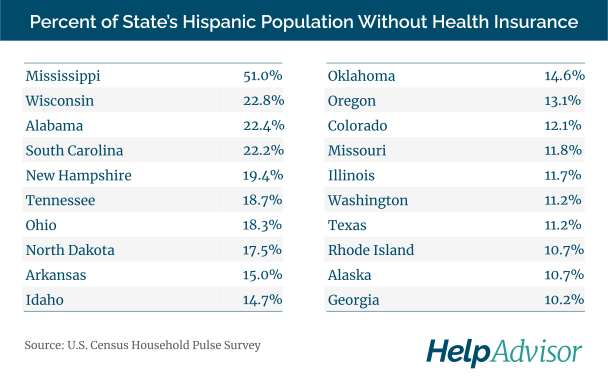
The chart below shows which states have the highest percentage of uninsured Hispanics. Of the top six states on this list, four are among the states with the highest disparities of unmet mental health needs between Hispanics and Whites.
Fortunately, there are resources available to uninsured Hispanics in need of mental health care. And many of those resources provide services that are free or are affordably priced on a sliding scale.
“Sliding scale services accommodate individuals of low-income households with session fees that are affordable, and in some instances, pro bono services,” Dr. Garcia said. “Many psychologists and counselors I know maintain one to two spots in their caseload for pro-bono services. Similarly, there are many counselors that focus on providing services for uninsured and underinsured individuals.”
The data used in this project comes from the U.S. Census Household Pulse Survey. The week used for analysis was Week 25, which spans February 17th through March 1st.
To understand the disparity between Hispanic Americans and the non-minority population, we compared the percentage of each demographic that answered “Yes” to needing professional mental health services but not receiving it for any reason. We also compared the total number of Hispanic Americans that selected “Yes” to this question to the total Hispanic American population in each state. The population data came from the 2019 U.S. Census.
We also compared the total number of respondents who cited not having health insurance to the total population of Hispanic Americans in each state.
The resources below are designed to benefit Hispanic Americans in need of mental health services. As April is National Hispanic Health Month and July is Minority Mental Health Month, we encourage everyone to reach out for help for yourself or a loved one.
The National Institute of Mental Health (NIMH) is the largest scientific organization in the world dedicated to research focused on the understanding, treatment, and prevention of mental disorders and the promotion of mental health.
Phone: (866) 615-6464
Resources on a wide range of health topics selected from approximately 1,400 government and non-profit organizations to bring you the best, most reliable health information on the Internet.
Phone: (800) 950-NAMI
MentalHealth.gov provides one-stop access to U.S. government mental health and mental health problems information.
Phone: (877) 696-6775
The NLBHA focuses on influencing national behavioral health policy, eliminating disparities in funding and access to services and improving the quality of services and treatment outcomes for Latino populations.
Phone: (505) 980-5156
BetterHelp.com helps make professional counseling accessible, affordable, convenient - so anyone who struggles with life’s challenges can get help, anytime, anywhere.
Phone: (888) 688-9296
Latinxtherapy.com connects the Latino community with culturally responsive therapists and speakers.
The NCOA delivers the resources, tools, best practices, and advocacy our nation needs to ensure that every person can age with health and financial security.
Phone: (571) 527-3900
The Lifeline provides 24/7, free and confidential support for people in distress, prevention and crisis resources for you or your loved ones and best practices for professionals.
Phone: (800) 273-8255
SAVE was one of the nation’s first organizations dedicated to the prevention of suicide. We provide suicide attempt survivor resources, depression screenings, grief support and more.
Phone: (800) 273-8255
There are millions of people struggling all over the world. And we want to help all of them. Everyone deserves free, 24/7, mental health support at their fingertips.
Phone: Text HOME to 741741
Established in 1987, the American Foundation for Suicide Prevention (AFSP) is a voluntary health organization that gives those affected by suicide a nationwide community empowered by research, education and advocacy to take action against this leading cause of death.
Phone: Text TALK to 741741
Trans Lifeline is a grassroots hotline and microgrants 501(c)(3) non-profit organization offering direct emotional and financial support to trans people in crisis – for the trans community, by the trans community.
Phone: (877) 565-8860
Learn more about mental health, mental disorders, treatments, prevention, and public health research on children’s mental health.
Phone: (800) 232-4636
Due to COVID-19 and the need for social distancing, USDA was able to make temporary changes so that meals may be taken home, and parents or guardians may pick meals for their children if the state allows. Families can use this tool to find directions to nearby sites as well as hours of operation and contact information.
Phone: (866) 348-6479
Kidshealth.org is a part of a nonprofit children’s health system. We aim to give you the tools to make the best health choices for you and your kids.
When a child lags far behind, fails to reach a developmental milestone, or loses a previously acquired skill, it may be time to evaluate if a mental or physical problem exists that could be considered a developmental disability. The resources on this site will help examine those possibilities.
Understood is a non-profit dedicated to serving the millions of families of kids who learn and think differently.
Autism Speaks is dedicated to promoting solutions, across the spectrum and throughout the lifespan, for the needs of individuals with autism and their families.
Phone: (888) 288-4762
Understand how to address weight issues in children and teens with healthy guidelines, links to interactive and skill-building tools, and more.
Phone: (301) 504-5414
StopBullying.gov provides information from various government agencies on what bullying is, what cyberbullying is, who is at risk, and how you can prevent and respond to bullying.
A health emergency brings many changes and much uncertainty for young children and their families, but there are things we can do to face each day with optimism and hope. The resources on this page can help families cope during challenging times.
ULifeline is an anonymous, confidential, online resource center, where college students can be comfortable searching for the information they need and want regarding emotional health.
Phone: (800) 273-8255
Learn Psychology provides resources to help students understand different psychological conditions, including addiction in college. While the resources provided can be great for gathering information, students in crisis should consult with a psychologist or call the helpline if in need of immediate support.
Phone: (800) 662-4357
The Coalition for Immigrant Mental Health (CIMH) is a collaborative community based and research informed initiative that is a partnership between immigrants regardless of status, mental health practitioners, community organizers, researchers, and allies.
SAMHSA's mission is to reduce the impact of substance abuse and mental illness on America's communities.
Phone: (877) SAMHSA-7
Our mission is to advance science on the causes and consequences of drug use and addiction and to apply that knowledge to improve individual and public health.
Phone: (301) 443-1124
Our mission at Recovery.org is to connect people and their families with the information and resources to help them recover from substance abuse and behavioral disorders.
Phone: (888) 775-8406
Smokefree.gov is an initiative from the National Cancer Institute to help you or someone you care about quit smoking.
Phone: (800) QUIT-NOW
HYSQ initiative was a multi-phase project designed to address the critical need to disseminate effective, developmentally appropriate cessation programs for adolescent smokers.
NAQC is an international, non-profit membership organization that seeks to promote evidence-based quitline services across diverse communities in North America.
Phone: (800) 398-5489
InformedImmigrant.com is both a digital hub and offline network offering the most up-to-date and accessible information and guidance for the undocumented immigrant community.
At My Undocumented Life blog, we seek to provide resources for undocumented immigrants, not just in regards to educational opportunities and immigration news, but also our health!
The Committee for Hispanic Children and Families envisions a future where Latino children, youth, and families have equitable access to opportunities to succeed, are empowered to realize their full potential, and are affirmed in their culture. We have put together this immigration resource guide to respond to a noticeable shift in our communities.
NEDA supports individuals and families affected by eating disorders, and serves as a catalyst for prevention, cures and access to quality care.
Phone: (800) 931-2237
Midieta specializes in meal plans intended to help Hispanics lose weight.
Through TOS's unique position, they lead the charge in advancing the science-based understanding of the causes, consequences, prevention and treatment of obesity.
Phone: (301) 563-6526
For more than 20 years, the National Resource Center on Domestic Violence (NRCDV) has been a comprehensive source of information for those wanting to educate themselves and help others on the many issues related to domestic violence.
Phone: (800) 799-7233
We are Latinas serving Latinas, reminding our survivors of their strength, courage, and value.
Phone: (303) 433-4470
Encuentro Latino is an online clearinghouse for research, training materials, handouts and other resources on domestic violence in Latin America and in Latino/Hispanic immigrant communities in the U.S.
Phone: (800) 799-7233
The National Sexual Assault Hotline was the nation's first decentralized hotline, connecting those in need with help in their local communities. It's made up of a network of independent sexual assault service providers, vetted by RAINN, who answer calls to a single, nationwide hotline number.
Phone: 1-(800) 656-4673
We answer the call to support and shift power back to people affected by relationship abuse.
Phone: 1-(800) 799-7233
Depression and anxiety can happen during pregnancy or after birth. Learn the signs and how to get help.
Phone: (301) 435-3458
Good mental health is essential to overall well-being. Many mental health conditions, such as depression and bipolar disorder, affect more women than men or affect women in different ways from men. Learn more about them in the guide below.
Phone: (800) 994-9662
Find important information on common menstrual cycle questions and concerns.
Phone: (800) 994-9662
More than 9 million women in the United States are diagnosed with an STI each year. Women often have more serious health problems from STIs than men, including infertility. Learn more about common STIs with the following guide from Womenshealth.gov.
